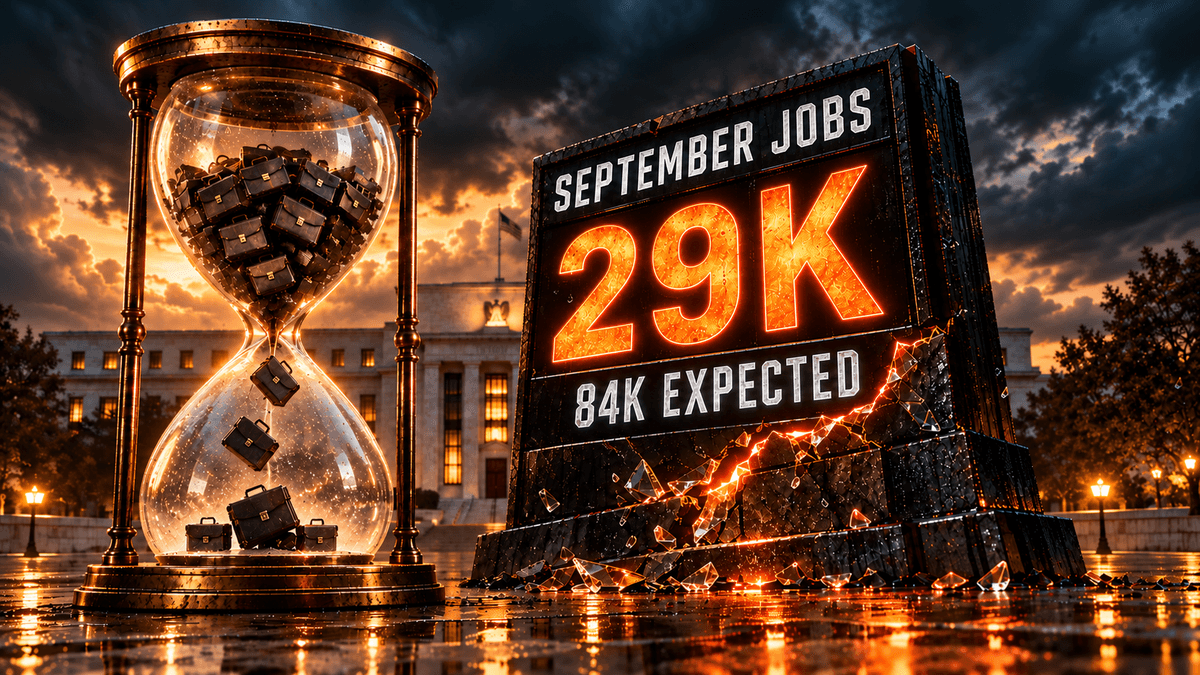
September Jobs: 29K vs 84K Expected. Fed Hike Still On?
octobre 02

Jerome Powell's era ended yesterday as Kevin Warsh was sworn in as the 17th Federal Reserve Chair — at the White House, for the first time since 1987. Markets are now pricing no cuts and a growing chance of a hike: the rate outlook just changed more than most portfolios have adjusted for.
Kevin Warsh was sworn in as the 17th Federal Reserve Chair at a White House ceremony on May 22, 2026, replacing Jerome Powell, who served eight years and remains on the Board of Governors until 2028. The confirmation vote was 54–45 — the most divisive in modern Fed history — with only one Democrat crossing party lines. Trump, who has repeatedly called for lower rates, told a rally Friday that rates would come down "very quickly." Warsh said publicly: "The president never asked me to predetermine any interest rate decision, nor would I ever agree to do so."
The Fed funds rate currently sits at 3.50%–3.75%, held steady for three consecutive meetings. April CPI rose 3.8% year-over-year — a three-year high. April's FOMC meeting saw four dissenting votes, the most since 1992. Warsh's first meeting as chair is June 16–17. Markets have priced out all 2026 cuts; CME FedWatch shows December hike probability above 50%.
For two years, the market's default assumption was that the Fed's next move was a cut. That assumption is now dead. Warsh is a known hawk on inflation discipline — during his previous stint as a Fed governor from 2006 to 2011, he consistently favored tighter policy. He has also signaled interest in accelerating balance sheet reduction beyond Powell's passive runoff approach. Active selling of the Fed's MBS holdings would push long-term yields higher even without rate hikes.
The portfolio implications are direct. Rate-sensitive sectors — REITs, utilities, and long-duration tech — face a structurally more hostile Fed than they were pricing in three months ago. By contrast, financials benefit: banks earn more on loans when rates stay elevated, and deregulation signals from Warsh's background favor the sector. Energy stocks remain a hedge against the inflation backdrop that is forcing Warsh's hand.
The market spent all of 2025 waiting for rate cuts that never came. Now it faces a Fed chair whose credibility depends on proving he won't deliver the cuts the president expects — and that changes the calculus on nearly every asset class.
The wildcard is Powell himself. He stays on the Board until 2028, and a DOJ investigation means he didn't leave quietly. A divided FOMC — four dissenters at April's meeting — means Warsh must build consensus fast. His June 17 press conference will be the most closely parsed Fed communication in years.
Key Risk: If oil holds above $95 (US–Iran war effect) and CPI prints above 4% for two consecutive months, the probability of an emergency or off-cycle hike before September rises sharply — a scenario bond and equity markets are not currently pricing.
The Fed transition is the macro story of 2026. The right tools let you track it in real time and act before the crowd adjusts.
The Warsh era is just beginning — Profit Pro gives you the tools to stay ahead of every move.
Avis de non-responsabilité générale
Ce contenu est uniquement fourni à titre informatif et ne constitue pas un conseil financier ni une recommandation d’achat ou de vente. Les investissements comportent des risques, y compris la perte potentielle de capital. Les performances passées ne préjugent pas des résultats futurs. Avant de prendre des décisions d’investissement, prenez en compte vos objectifs financiers ou consultez un conseiller financier qualifié.
Non
Un peu
Bon