September Jobs: 29K vs 84K Expected. Fed Hike Still On?
October 02

After 24 years of secrecy, SpaceX finally opened its books. The numbers reveal two very different companies bundled into one ticker — and a valuation that prices perfection on both.
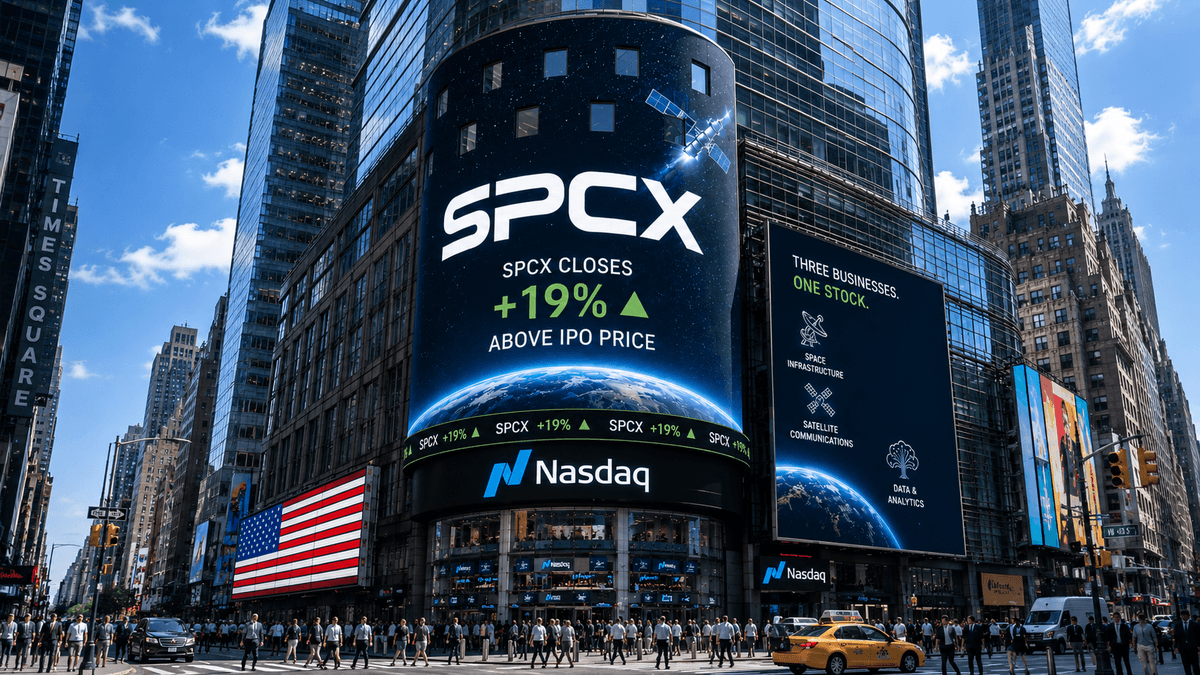
On the evening of May 20, SpaceX filed its S-1 registration statement with the SEC, marking the first time in the company's history that its finances are public. The filing targets a Nasdaq listing under SPCX, with the roadshow beginning June 4, pricing on June 11, and first-day trading on June 12. The deal aims to raise up to $75 billion at a valuation of $1.75–2 trillion — which would make it the largest IPO in history by a wide margin, nearly tripling Saudi Aramco's 2019 record. Elon Musk is not selling personal shares. Retail investors are reportedly allocated up to 30% of the float.
The headline financials: $18.7B in 2025 revenue (+33% YoY), a $4.9B net loss, and $6.6B in adjusted EBITDA. But those consolidated numbers obscure what's actually going on — the S-1 reports three segments with dramatically different financial profiles.
The core insight buried in the S-1: SpaceX is a highly profitable satellite internet business that is using its cash flows to fund one of the largest AI infrastructure buildouts on earth. Starlink generated a 63% EBITDA margin in 2025 — better than most software companies — on $11.4B in revenue. Subscriber count doubled in 12 months. This business alone would justify a substantial valuation.
Then there's xAI, acquired in February 2026, whose losses have been retroactively folded into SpaceX's financials. xAI spent $12.7B in capex in 2025 — more than the rocket and satellite divisions combined — and burned another $7.7B in Q1 2026 alone. Without xAI, the standalone SpaceX was net income positive in 2024. The GAAP losses you're reading in headlines are almost entirely an AI story.
A profitable satellite empire is subsidizing an AI arms race. Whether that's visionary capital allocation or reckless spending on unproven revenue is the central question of this IPO.
The valuation math is demanding. At $1.75T valuation, SPCX lists at roughly 110× trailing revenue — higher than any major tech IPO at debut in history. The bull case requires xAI's Grok subscriber base and Colossus data center compute to scale into those losses. The bear case is simpler: Starlink's average revenue per user has fallen from $99/month in 2023 to $66/month in Q1 2026 as SpaceX cuts prices to grow volume, which limits how long Starlink can carry the AI buildout.
Key risk: xAI's net cash burn approached $9B in Q1 2026. At that pace, the $75B IPO raise covers roughly 8 quarters — assuming no material AI revenue growth. The S-1 flags this explicitly in its risk factors.
Whether you're planning to invest on day one or simply want to follow one of the most anticipated IPOs in history, having the right tools can help you stay ahead of the market.
With Profit Pro, you can:
Whether you plan to invest or simply follow the story, Profit Pro gives you the tools to stay ahead of one of the most anticipated IPOs in history.
General Disclaimer
This content is for informational purposes only and does not constitute financial advice or a recommendation to buy or sell. Investments carry risks, including the potential loss of capital. Past performance is not indicative of future results. Before making investment decisions, consider your financial objectives or consult a qualified financial advisor.
Nope
Sort of
Good