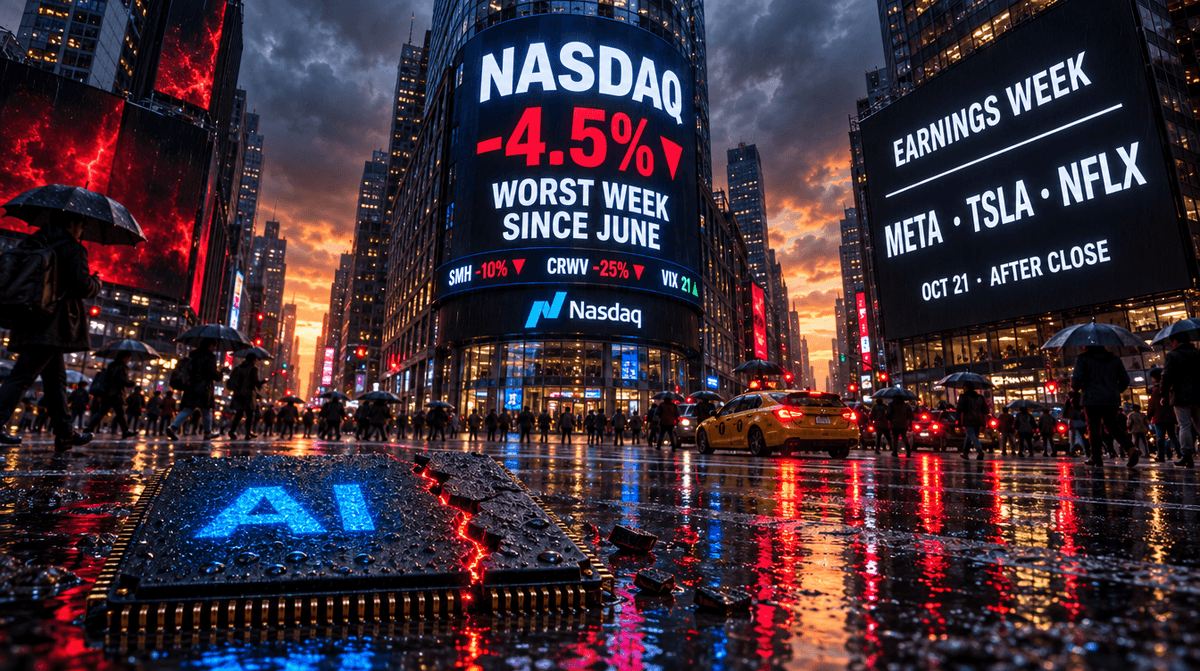
Nasdaq Worst Week Since June: AI Debt Fear Meets Biggest Earnings Week of Q3
10월 19

The US economy added just 29,000 jobs in September — less than a third of the 84,000 Dow Jones consensus, and the weakest print since June's 57,000. Unemployment ticked up. The 30-year Treasury yield was already near 24-year highs. The October 27–28 FOMC meeting was already ~50/50 on a hike. This print changes that math — but not in the direction you might expect.
The Bureau of Labor Statistics reported this morning that the US economy added 29,000 nonfarm payroll jobs in September — far below the Dow Jones consensus of 84,000, the Reuters/Bloomberg survey of ~90,000, and the FactSet estimate of 95,000. The miss is made more striking by Wednesday's ADP private payrolls of 90,000 — which gave the market no warning. The unemployment rate ticked up from 4.1%, reversing August's improvement. Average hourly earnings rose 0.3% month-over-month. The 4-week jobless claims average had been healthy at 200,000 — making today's headline genuinely surprising. The S&P 500 closed Thursday at 7,692 (+0.34%). The 30-year Treasury yield was near 24-year highs entering the session. Nike plunged 10.4% premarket on falling revenue and 2027 layoffs — an independent consumer demand warning. The US Dollar Index fell 0.23% on the print as traders priced out the October hike. Markets close at 1pm ET today. The next FOMC meeting is October 27–28 — 25 days away.

The complexity of today's print is that it doesn't cleanly resolve the October hike debate — it muddies it. In a normal rate environment, 29,000 jobs and a rising unemployment rate would end the hike conversation immediately. But Warsh's dot plot was built on an inflation concern, not a labor market concern. The 30-year Treasury yield near 24-year highs signals bond markets are already pricing significant fiscal and inflation risk — and average hourly earnings rising 0.3% month-over-month means wages are not cooling. Warsh faces a precise version of the scenario he has tried to avoid: the labor market softening while wages remain sticky and yields near multi-decade highs. That combination — weaker growth, persistent wage pressure, elevated long-end yields — is stagflation's early fingerprint.
For traders, the immediate read-through is nuanced. Rate-sensitive sectors — REITs, utilities, homebuilders — benefit if the market reads 29K as "hike is off the table." But if the bond market interprets the same number as confirmation that fiscal spending and inflation are running independently of the labor market, long yields could rise further even with a weak NFP. That would be the worst outcome for equity valuations: no rate hike relief from the Fed while the bond market reprices duration risk higher on its own.

August printed 162,000 and looked like a labor market resurgence. September printed 29,000. The truth is almost certainly somewhere in between — but Warsh has to make a rate decision in 25 days on data that is giving him contradictory signals every month. The Fed's credibility is now more at risk from a wrong move than from no move at all.
The broader picture entering Q4: the S&P 500 is 1.6% below its August all-time high of 7,816.70, having declined 0.71% over the past month despite being up 14.54% year-over-year. The market is range-bound — waiting for a macro catalyst. Today's NFP may provide it, but the direction depends entirely on whether Warsh signals October is live or off the table in the days ahead.
Key Risk: Bank of America estimated September jobs at only ~60,000 — a downside outlier that proved prescient. If BofA is also right about their three-hike scenario for 2026, today's print doesn't remove the hike risk — it defers it. A Warsh speech next week that dismisses the miss as "statistical noise" would send long yields to new multi-decade highs. Watch for any Fed communication before October 10.
29K jobs. Rising unemployment. 24-year yield highs. FOMC in 25 days. Here's what to do before the weekend.
October 15 CPI and October 27–28 FOMC are the next two events that will determine the rate outlook. Profit Pro keeps the data in one place.
일반적인 면책조항
이 콘텐츠는 정보 제공을 목적으로 하며, 재정적 조언이나 매매 권유를 구성하지 않습니다. 투자에는 자본 손실의 위험을 포함한 위험이 따릅니다. 과거의 성과는 미래 결과를 보장하지 않습니다. 투자 결정을 내리기 전에 재무 목표를 고려하거나 자격을 갖춘 재무 상담사와 상담하십시오.
아니요
어느 정도
좋음