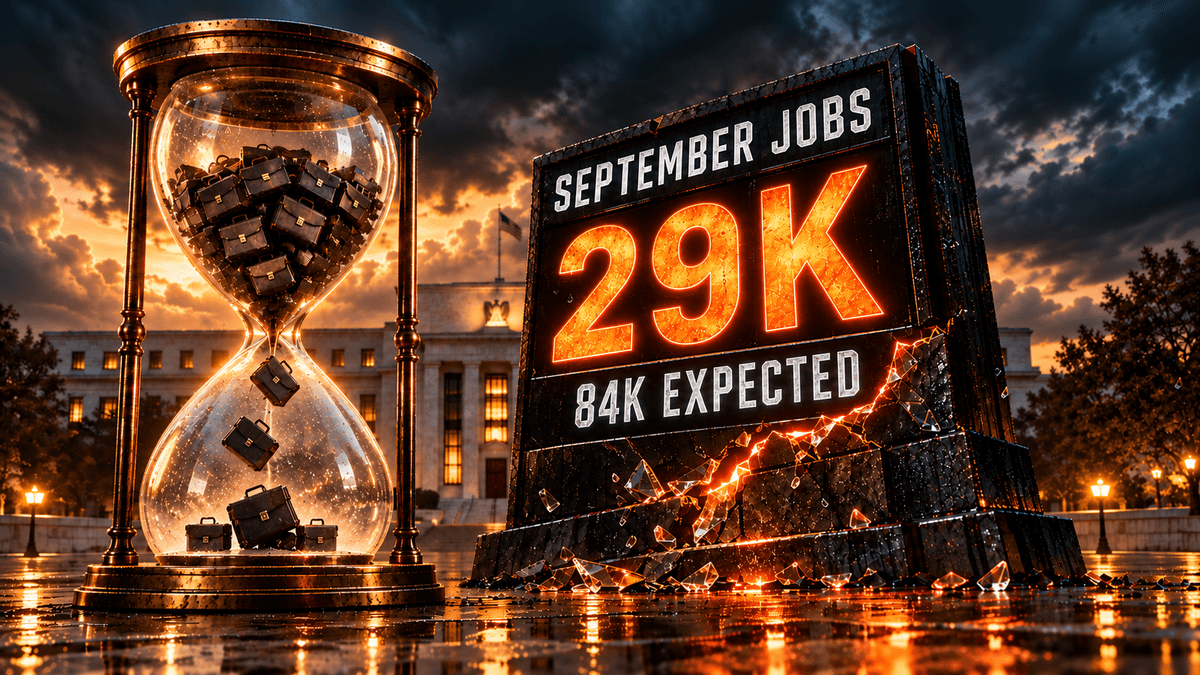
September Jobs: 29K vs 84K Expected. Fed Hike Still On?
10月 02

Nasdaq Worst Week Since June: AI Debt Fear Meets Biggest Earnings Week of Q3
The Nasdaq fell 4.5% last week — its worst performance since June — as fears about AI debt and Chinese chip competition hit semiconductors hard. SMH lost 10%. CoreWeave dropped 25%. Today markets are bouncing, but the real test arrives Tuesday through Thursday: Meta, Tesla, Netflix, and SPCX all report. Either the earnings justify the buildout, or the selloff resumes.
Last week was the worst for the AI trade since June. The Nasdaq lost 4.5% and snapped a four-week winning streak. The S&P 500 fell 1.95%. The VanEck Semiconductor ETF (SMH) dropped 10% — its largest weekly decline since April 2025 — led by Micron (MU) −5.63%, AMD, and SanDisk. The trigger was twofold: concern about Chinese chip manufacturers undercutting US AI hardware on price, and growing alarm about the debt mountain AI infrastructure companies are accumulating.
CoreWeave, the Nvidia-backed neocloud operator, became the symbol of that second fear — its total debt has now passed $51 billion, and the stock fell 25% on the week. The Philadelphia Semiconductor Index logged its longest losing streak since the 2008 financial crisis. South Korea's KOSPI fell over 14% — its worst week since 2008. Brent crude touched $110 mid-week before pulling back. By Friday's close, both the S&P 500 and Nasdaq had broken below their 50-day moving averages and the VIX climbed close to 22 for the first time in four months.
Today, stocks are bouncing — the Nasdaq 100 is up 1.9%, the S&P 500 up 0.8%, and the chip index is recovering 3.5%. Goldman Sachs upgraded CoreWeave this morning, calling last week's selloff overdone. But this is a positioning move ahead of earnings, not a verdict.


Last week's selloff had a specific thesis: AI companies are borrowing too much, spending too fast, and the revenue to justify it is arriving too slowly. CoreWeave's $51 billion debt load became the symbol of that concern. But the problem with the thesis is that CoreWeave's debt is backed by long-term GPU contracts — the same contracts that make Micron's $100 billion backlog credible and NVDA's order book bulletproof. The market is not questioning whether AI demand is real. It is questioning whether the financing structure is sustainable if rates stay elevated under Warsh.
This week's earnings are the direct response. Meta (Oct 21) will show whether AI investment is converting to advertising revenue at scale — its Q3 capex guidance is the single most-watched number. Tesla (Oct 21) is the Musk proxy and Cybercab conviction test. SPCX (Oct 21) reports Q3 — the quarter in which Google's compute contract was supposed to begin contributing meaningful revenue. If the contract is ramping and AI capex is moderating, the selloff thesis evaporates. If xAI burned another $9B+ in Q3 with no new revenue surprise, the debt concern becomes structural.
Today's rebound is a positioning move, not a verdict. 77% of October's worst-performing S&P 500 stocks are higher today, while 91% of October's strongest performers are lower — a textbook mean-reversion rotation with no new fundamental information. The verdict comes Tuesday night when Meta, Tesla, and SPCX all report after close. Until then, the 1.9% Nasdaq gain is noise.
Key Risk: The October 27–28 FOMC sits immediately after this earnings week. If Meta or Tesla disappoint Tuesday night and sentiment turns risk-off again, Warsh walks into a press conference with both a weakening AI trade and a fragile equity market. His response to that combination — hold neutral vs. signal concern — could amplify any earnings-driven selloff into something more systemic. TThe VIX touching 21.36 intraday on Friday — its highest level in four months — means options markets are pricing meaningful tail risk into earnings week. October hike odds currently sit at approximately 34% following the September NFP miss.
212 companies report this week. Three nights decide the narrative.
Tuesday Oct 21 is the most information-dense evening of Q3. Oct 27–28 FOMC closes the loop. Profit Pro keeps the data in one place.
一般的な免責事項
この市場リサーチで掲載されている情報およびデータは、Darqube Ltdの市場調査部門によって作成されています。当社の調査部門の出版物およびレポートは、情報提供を目的として提供されています。市場データや数字は目安であり、Darqube Ltdは金融商品の取引を行っておらず、投資の推奨や決定を提供するものではありません。このレポートに含まれる情報と分析は、当社の調査部門が客観的かつ透明性があり、信頼性があると考えている情報源を基に作成しております。
いいえ
まあまあ
良い