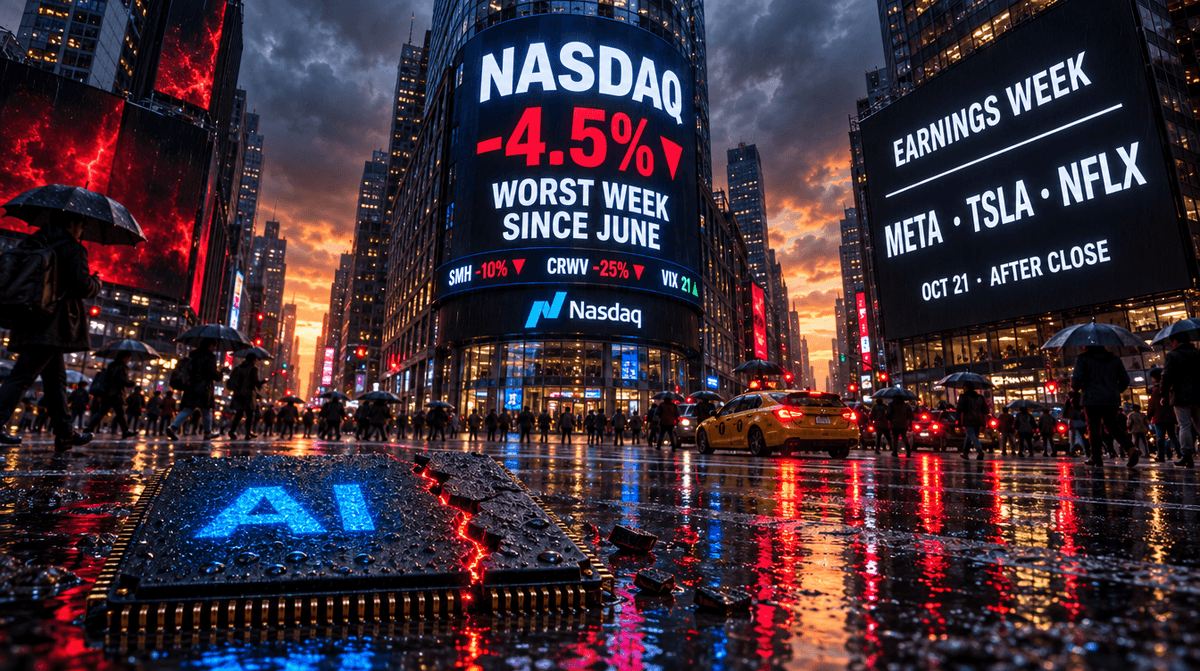
Nasdaq Worst Week Since June: AI Debt Fear Meets Biggest Earnings Week of Q3
października 19

The New York Times reports OpenAI is leaning toward pushing its IPO to 2027, citing SPCX's post-debut decline and AI market volatility. The Nasdaq fell 4.6% this week — its worst week since April. Iran fired on ships again. But consumer sentiment, PCE, and GDP all surprised positively. The market is sending two contradictory signals. Here's how to read them.
The Nasdaq closed Friday at 25,297.62, down 4.6% for the week — its worst weekly performance since April. The S&P 500 ended at 7,354.02, off 1.8% for the week. The Dow outperformed, rising 0.6% on the week to 51,876.11. The week's tech damage: Apple −6.2% Thursday after announcing Mac and iPad price hikes; Microsoft −3.5% after Xbox price increases; MU surged 15.7% on its historic earnings Thursday, then fell 6.7% Friday. The week's defining story arrived Friday via The New York Times: OpenAI is leaning toward delaying its IPO to 2027, citing SpaceX's post-debut share decline and growing investor concern about the sustainability of AI infrastructure spending. JPMorgan analysts noted the delay raised questions about capital market access for the AI wave. Iran compounded the pressure: Trump announced Iran fired four attack drones at cargo ships in the Strait of Hormuz, declaring the ceasefire violated — though tanker traffic continued largely unimpeded and oil fell 3.5% on the week. On the macro side, three positive surprises: Q1 GDP final estimate revised up to +2.1% (from 1.6%), May PCE came in below expectations, and University of Michigan consumer sentiment printed in line with consensus.
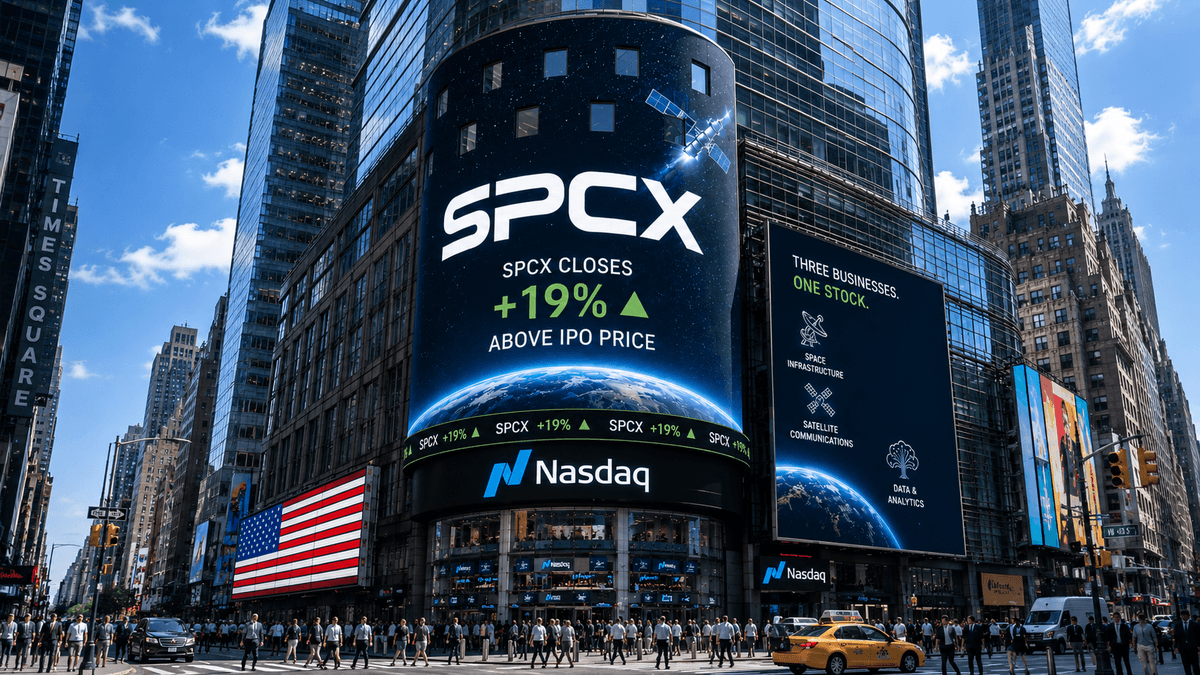
The OpenAI IPO delay is not just a story about one company. It is a market structure signal. The AI IPO pipeline — estimated at $3.6 trillion including OpenAI, Anthropic, xAI, Scale AI, and others — was expected to be the defining capital markets story of late 2026. SPCX's post-IPO decline from $176 to below $155 in less than two weeks has done something no bear case or valuation model could do: it gave every AI company's CFO a real-world data point that the market cannot absorb multiple mega-cap AI IPOs in quick succession at triple-digit revenue multiples.
For traders, the OpenAI delay has a specific read-through. The companies most exposed to an OpenAI IPO delay are the ones that were pricing in an imminent capital raise as validation of the AI investment thesis: NVDA (OpenAI's largest GPU customer), MSFT (49% OpenAI stakeholder), and SPCX (whose xAI unit competes directly with OpenAI for the same GPU supply). The companies that benefit: Anthropic (now the only credible near-term AI IPO candidate) and Broadcom (whose Jalapeño chip with OpenAI becomes more strategically important if OpenAI stays private longer and self-funds compute).
SPCX didn't just have a bad IPO week — it changed the calculus for every AI company watching from the sidelines. When the largest IPO in history trades down 25% from its peak in ten days, the second-largest IPO in history gets postponed. That's how capital markets work.
Micron made the point sharper. The company reported $41.5 billion in revenue, 84.9% gross margins, and guided $50 billion next quarter — numbers with no precedent in semiconductor history. The stock surged 15.7% Thursday. By Friday's close it had given back nearly half that gain. This is the same dynamic playing out across AI stocks: earnings are real, valuations are stretched, and every rally is being sold into. The market is not questioning whether AI is working — Micron's $100 billion in contracted revenue proves it is. It is questioning whether any price is the right price to pay for it right now.
The Iran drone attack is the second signal to hold. Trump has declared the ceasefire violated, but tanker traffic continues through the Strait. Oil fell 3.5% on the week despite the drone attack because the market is treating this as diplomatic noise, not supply disruption — yet. If Iran escalates from drones to an actual tanker seizure, oil would spike above $85 immediately and the energy disinflation that is suppressing rate-hike odds would reverse overnight. This is the tail risk that can reprice everything before July 11 CPI.
Key Risk: Markets were closed Friday July 4th — a shortened week with June NFP printing Thursday July 3rd. If Iran escalates before July 3rd and oil spikes above $85, the NFP will land into a market already stressed by geopolitical risk. The combination of a strong jobs number (like May's 172,000 double-beat) and renewed oil inflation in a single week could push rate-hike odds back above 70% — the scenario that ends the rotation trade and hits everything simultaneously.
The Nasdaq had its worst week since April. The OpenAI IPO delay is a regime signal. Iran is unpredictable. But the economy is fine. Here's how to stay positioned for both the risks and the opportunities heading into July.
The AI IPO wave just paused. The economy is fine. July's data will tell us which one matters more. Profit Pro keeps you ready for both answers.
Ogólne Ostrzeżenie
Niniejsza treść ma charakter wyłącznie informacyjny i nie stanowi porady finansowej ani rekomendacji zakupu lub sprzedaży. Inwestycje wiążą się z ryzykiem, w tym z możliwością utraty kapitału. Wyniki osiągnięte w przeszłości nie stanowią gwarancji wyników przyszłych. Przed podjęciem decyzji inwestycyjnych rozważ swoje cele finansowe lub skonsultuj się z wykwalifikowanym doradcą finansowym.
Nie
Trochę
Dobrze